
Halifax County Clerk Contact
The Halifax County court contact directory routes clerk, judge, district attorney, family court, arbitration, Guardian ad Litem, and magistrate contacts through the courthouse directory. The research file found a conflict in current official naming for the individual clerk, so the safest build language uses the office name instead of choosing between conflicting names.
Halifax County Clerk of Superior Court
Halifax County Courthouse
357 Ferrell Lane
Halifax, NC 27839
Mailing: PO Box 66, Halifax, NC 27839
252-593-3000
Monday-Friday, 8:30 a.m.-5:00 p.m.
The directory is important for Halifax County clerk users because records, court dates, payments, and judge contacts are tied to the same courthouse system.
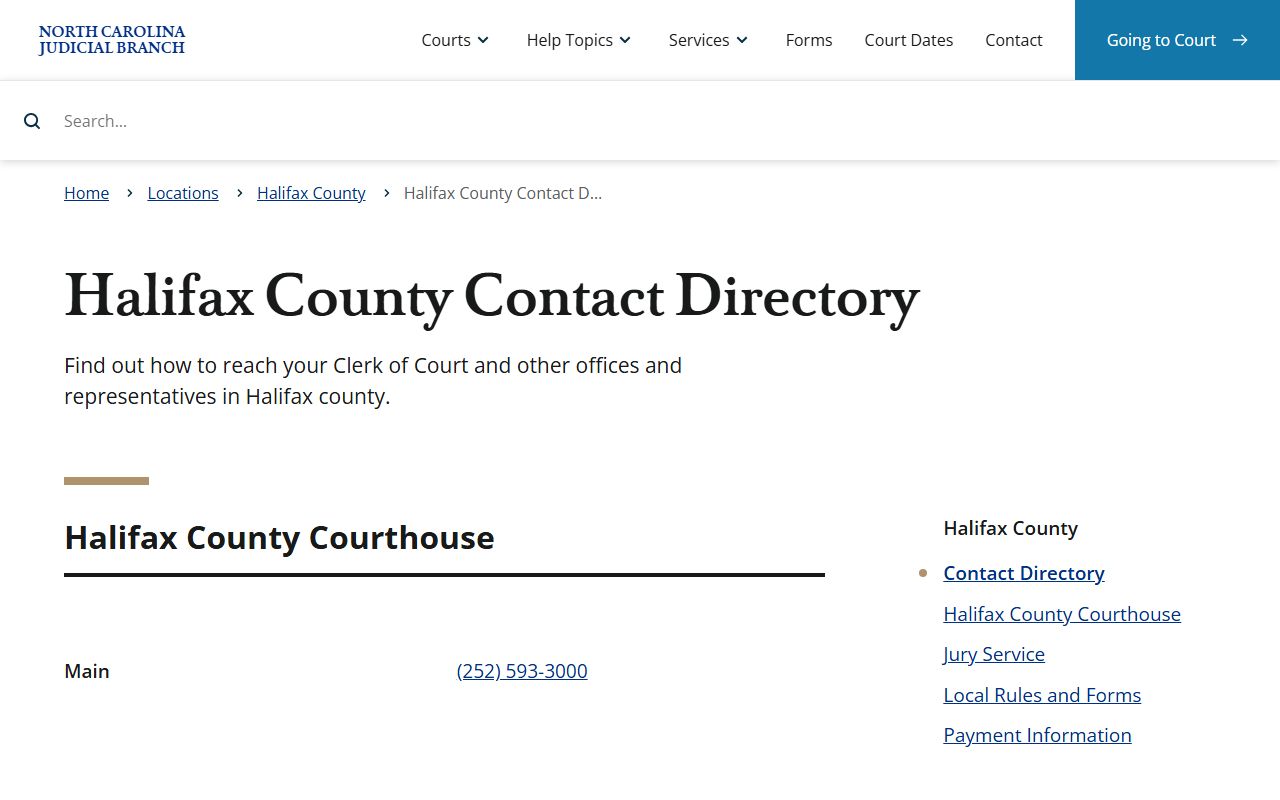
The directory image supports the local contact card by showing the official Judicial Branch contact source for Halifax County court offices.
What Halifax County Clerk Maintains
North Carolina uses a unified clerk structure for state trial court records. In Halifax County, the Clerk of Superior Court is the records gateway for criminal cases, civil cases, family court files, special proceedings, estate and probate files, copy requests, and public terminal access. The clerk is different from the Register of Deeds, which handles marriage licenses and certificates, birth and death certificates, real estate records, and recorded instruments.
- Criminal court case files, including public case information and file copies when available.
- Civil, family, and special proceeding files filed in Halifax County courts.
- Estate and probate records handled before the clerk as probate judge.
- Public self-service terminal access for case information searches.
- Certified, plain, or exemplified court-document copies when clerk staff can provide them.
Official Judicial Branch guidance says paper court files must be accessed through the clerk's office in the county where the case is located. For Halifax County filings, that means the Halifax Clerk of Superior Court rather than a statewide administrative records request.
Request Certified Halifax Court Copies
Certified copies are used when a person needs an official court document rather than a web search result. The clerk can provide copies of documents in court files for a fee when the document is public and available. Requests work best when the requester has a case number, party names, filing year, document name, and the number of copies needed.
- Identify the Halifax County case by case number if available, or by full party name and approximate filing date.
- Confirm whether the record is criminal, civil, family, special proceeding, estate, or another clerk-held court file.
- Contact or visit the Clerk of Superior Court and state whether a plain, certified, or exemplified copy is needed.
- Pay the required copy or certification fee using an accepted channel, then pick up or receive the copy as directed by clerk staff.
Note: Portal results are useful for lookup, but certified documents come from the clerk's official court file.
Halifax Clerk Request Fields
A Halifax County court copy request does not need a complicated form when the requester can provide clear case identifiers. The same details help clerk staff find the file in Portal, the public terminal, or the paper record.
| Field | Needed? | Why It Matters |
|---|---|---|
| Case number | Best if known | Fastest way to locate a court file or docket entry. |
| Party names | Yes | Needed when the case number is unknown or multiple cases match. |
| Record type | Yes | Separates criminal, civil, family, estate, and special proceeding records. |
| Document requested | Yes | Examples include judgment, order, will, letters, disposition, or certified copy. |
| Copy type | Yes | Plain, certified, and exemplified copies serve different purposes. |
| Requester contact | Yes | Lets clerk staff follow up about fees, pickup, or mailing details. |
Halifax County Clerk Payments
The Halifax County payment information page gives specific payment rules for court fees, fines, and eligible traffic citations. Mail payments must use money order or certified check, payable to the Halifax County Clerk of Superior Court. Cash and personal checks are not accepted by mail. In-person payments are made at the first-floor Clerk of Superior Court's Office.
| Channel | Accepted Detail |
|---|---|
| Money order or certified check only, payable to Halifax County Clerk of Superior Court; include citation number when paying an eligible citation. | |
| In person | Cash, credit or debit card with processing fees, money order, or certified check; no personal checks. |
| Online | Eligible matters through NC Judicial Branch services or Portal with credit or debit card and processing fees. |
| Portal payment limits | Portal accepts major cards but states Apple Pay, Google Pay, Cash App, Venmo, and similar apps are not accepted. |
| Background checks | Judicial Branch guidance says use the county clerk's office rather than Portal for background-check-style searches. |
Halifax County court users should match the payment channel to the matter. A traffic waiver, a criminal cost, an estate filing, and a copy request may not all use the same workflow.
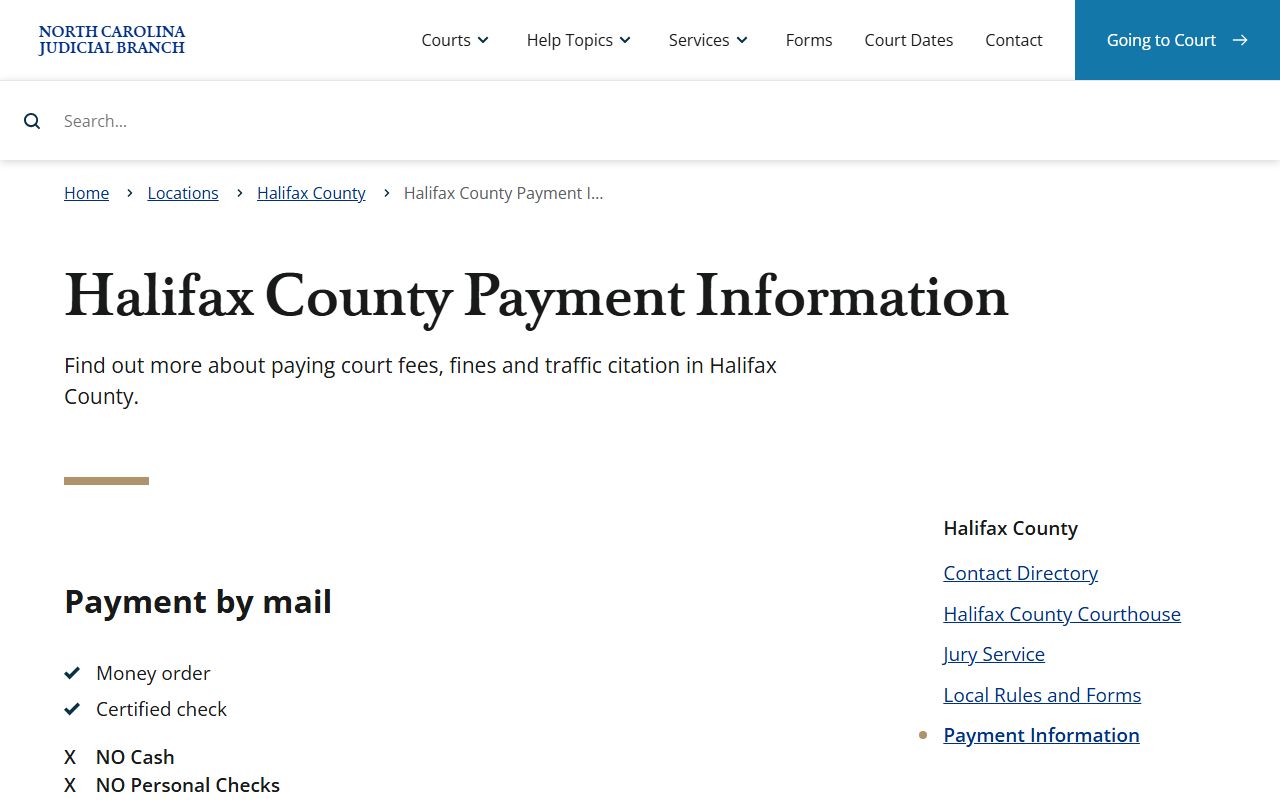
The payment image ties clerk copy and cost requests back to the official Halifax County payment source.
Halifax County Clerk Fees
The research file confirmed that clerk copy fees exist and that the Judicial Branch current court-costs page links statewide fee PDFs for civil, criminal, estates, special proceedings, and miscellaneous costs. It also noted a commonly published North Carolina copy-fee pattern, but the exact current PDF could not be extracted locally during research. For final dollar amounts, the clerk or current statewide schedule should control.
| Fee Item | Build Treatment |
|---|---|
| Plain court-document copy | Clerk provides for a fee; verify current page and per-page amount. |
| Certified court-document copy | Verify current certification and per-page amount before ordering. |
| Exemplified court-document copy | Verify current statewide miscellaneous court cost schedule. |
| Civil, criminal, estates, and special proceeding costs | Use the current statewide court-cost PDFs. |
| Credit or debit card payments | Processing fees apply when accepted. |
The Judicial Branch court costs overview is the public starting point for current statewide schedules.
The court-cost overview supports Halifax County clerk fee requests because North Carolina court costs are set on statewide schedules.
Clerk Records vs Public Requests
The Judicial Branch public records request guidance distinguishes court documents from administrative public records. Court documents should be requested from the clerk where the case was filed. For Halifax County court files, that points back to the Clerk of Superior Court, public terminal, and paper file access.
Administrative Judicial Branch records use a different public-records process. Sheriff records, jail and booking information, law-enforcement reports, Register of Deeds filings, and NCDMV driver records are also separate channels. This split matters because a clerk request for a divorce judgment, estate file, or criminal disposition is not the same as a sheriff request for an incident report or a Register of Deeds request for a marriage certificate.
The public-records image reinforces the most important routing rule: Halifax court case documents belong with the clerk where filed.